



Video Wall Display Buyer’s Guide 2026: Expert Tips & Reviews
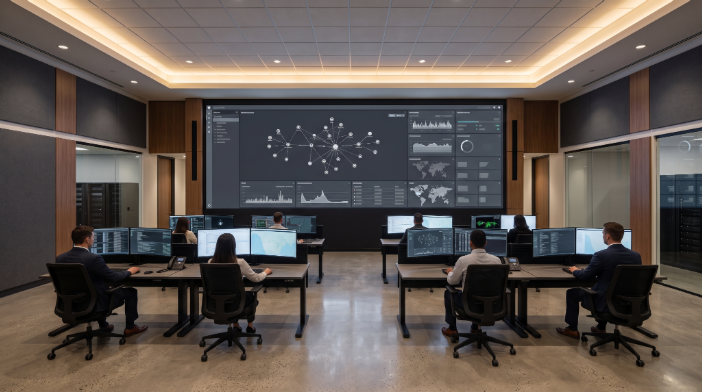
Enterprise video wall installations across Dubai and the GCC frequently run into trouble when treated like standard TV setups.Between 3,000+ lux ambient daylight washing out glass atriums, heavy HVAC thermal loads, and zero-latency routing requirements in 24/7 command centers, selecting hardware demands actual optical and electrical engineering not just measuring wall dimensions.
At DTIS (Digitech Integrated Solutions), we deliver commercial AV integrations across the UAE engineered for high-heat, high-ambient-light environments. This guide breaks down the technical benchmarks IT directors and AV consultants need before tendering: Direct-View LED (dvLED) versus tiled LCD trade-offs, pixel pitch formulas, BTU heat calculations, and enterprise AV-over-IP transport layers.
1. Quick Decision Matrix: Direct-View LED (dvLED) vs. Commercial LCD
Before examining controller cards and diode packaging, procurement teams must decide on the fundamental display architecture.
| Critical Factor | Direct-View LED (dvLED) | Commercial Tiled LCD |
| Visual Seam | 0.0 mm (100% True Seamless) | 0.44 mm – 3.5 mm Visible Bezel Lines |
| Peak Brightness | 800 to 4,000+ nits (Customizable) | 500 to 700 nits (Fixed Backlight) |
| Operational Lifespan | 100,000 Hours to Half-Brightness (L50) | 50,000 Hours (Backlight Degradation) |
| Ambient Light Tolerance | High; cuts through direct facade glare | Poor; prone to surface reflection and wash-out |
| Form Factor Flexibility | Flat, Concave, Convex, 90° Corners, Wraparound | Rigid flat rectangular matrix grids only |
| Serviceability | Modular (Individual diode card / hub swap) | Panel-level (Entire screen replacement required) |
| CapEx vs. OpEx | Higher initial CapEx / Lower 10-year OpEx | Lower initial CapEx / Higher replacement OpEx |
Direct-View LED (dvLED)
DVLED technology utilizes an array of individual light-emitting diodes mounted directly onto cabinet tiles. Because the diodes generate both color and illumination without a secondary backlight layer, dvLED delivers absolute black levels, wide viewing angles without contrast loss, and high refresh rates up to 3,840 Hz. Most importantly, it scales to arbitrary aspect ratios including 21:9 ultra-wide panoramic layouts for Microsoft Teams Rooms and multi-source command displays with zero bezels breaking up complex graphics or CCTV camera grids.
Ultra-Narrow Bezel (UNB) Commercial LCD
Commercial LCD video walls mount industrial-grade liquid crystal displays within ultra-narrow enclosures (ranging from 3.5 mm down to 0.44 mm bezel-to-bezel). While LCD remains a budget-conscious option for internal training rooms and static monitoring desks, it presents long-term maintenance hurdles:
- The Grid Effect: Even a 0.44 mm seam disrupts fine lines in CAD drawings, financial charts, and facial surveillance feeds.
- Color Drift & Backlight Aging: Replacing a single failed LCD panel after three years inevitably introduces visible color temperature and luminance mismatches against aged neighboring panels.
2. Technical Evaluation: Optics, Diode Packaging & Room Physics
Specifying display hardware requires matching physical metrics to the room’s viewing environment rather than buying maximum paper specifications.
Pixel Pitch Selection: The Mathematical Formula
Pixel pitch (P) is the center-to-center distance between adjacent diode clusters in millimeters. Specifying an unnecessarily tight pixel pitch inflates project CapEx exponentially; buying too wide a pitch results in visible pixelation (the “screen-door effect”).
Use these field-tested geometric optics formulas to calculate the minimum comfortable viewing distance the point where an observer with 20/20 vision perceives a continuous, uninterrupted image:
Minimum Viewing Distance (Meters) = Pixel Pitch (mm) × 2.4
Minimum Viewing Distance (Feet) = Pixel Pitch (mm) × 8.0
| Pixel Pitch (mm) | Min. Viewing Distance | Primary Enterprise Application |
| P0.7 – P0.9 | 5.5 to 7.2 ft (1.7 – 2.2 m) | Tactical Command Centers, Crisis Suites, NOC Console Consoles |
| P1.2 – P1.5 | 9.6 to 12.0 ft (2.9 – 3.6 m) | Executive Boardrooms, Parliament/Council Chambers, Broadcast Sets |
| P1.8 – P2.0 | 14.4 to 16.0 ft (4.3 – 4.9 m) | Corporate Lobbies, Auditorium Stage Backdrops, Town Halls |
| P2.5 – P3.0+ | 20.0 to 24.0+ ft (6.0 – 7.3 m) | High-Traffic Atriums, Retail Facades, Public Transit Concourses |
Critical Procurement Rule: If your display will show fine UI text, scannable geographic maps, or multi-split CCTV feeds, calculate your pixel pitch using the closest seated operator’s chair, not the average room depth.
Diode Packaging: SMD vs. COB vs. MIP
In fine-pitch dvLED engineering, the packaging technology dictates physical durability, thermal distribution, and optical contrast:
- Surface-Mount Diodes (SMD): Individual diode packages are soldered to the circuit board. While cost-effective and easy to source, SMDs are vulnerable to physical edge damage during maintenance and offer lower resistance to moisture and dust ingress.
- Chip-on-Board (COB): Micro-LED dies are bonded directly to the substrate and sealed with an optical resin flood coat. COB provides an impact-resistant, dust-proof, and anti-static surface that can be wiped clean, making it ideal for high-traffic environments and tactile interactive displays.
- Micro-LED in Package (MIP): Diodes are packaged and bin-tested individually at the micro-scale before robotic board placement. MIP balances the optical uniformity of SMD with the mechanical resilience and deep contrast of COB.
Ambient Light Dynamics & Luminance Targets
Screen brightness must be engineered to overcome ambient illuminance (measured in lux). Across commercial projects in Dubai and the GCC, extensive curtain-wall glass architecture routinely creates ambient light levels of 2,500 to 5,000+ lux in lobbies and atriums.
- Controlled Boardrooms (150 – 300 lux): 600 to 800 nits provides high readability without viewer eye fatigue.
- Corporate Lobbies with Ambient Daylight (500 – 1,000 lux): 1,200 to 1,500 units ensures brand assets and video streams remain punchy.
- Double-Height Glass Atriums & Facades (2,500+ lux): Requires 3,000 to 4,500+ nits paired with high-contrast black-mask encapsulation to prevent daylight washout.
3. Thermal Loading, HVAC & Power Infrastructure
A commercial video wall acts as an active electrical heat source. AV integration failures often trace back to overheating receiver cards, thermal throttling, and color drift caused by uncalculated HVAC loading.
Calculating Video Wall Heat Dissipation
To determine the additional cooling load an LED wall introduces to a facility, convert total operating wattage into British Thermal Units per hour (BTU/hr):
Field Example: A 6m × 3m corporate lobby dvLED wall drawing an average continuous load of 3,500 W generates:
3,500 × 3.412 = 11,942 BTU/hr
This output represents approximately 1.0 ton of dedicated cooling capacity. If the mechanical design omits a dedicated cold-air return above the display’s top exhaust vents, trapped heat will accelerate diode degradation and cause premature power supply failure.
Common-Cathode vs. Common-Anode Architecture
To mitigate thermal loading in hot climates, specify Common-Cathode power architecture rather than legacy Common-Anode designs:
- Common-Anode (Legacy): Supplies a uniform high voltage (typically 5V) to the Red, Green, and Blue diodes simultaneously. Because Red diodes require lower operational voltage (~2.1V) than Green and Blue (~3.2V), the excess voltage dissipates as waste heat.
- Common-Cathode (2026 Standard): Supplies independent, dedicated voltages directly to Red, Green, and Blue dies. This reduces display surface operating temperatures by 10°C to 15°C, cuts overall power consumption by 30% to 40%, and significantly reduces building HVAC wear.
4. Signal Processing: AV-over-IP vs. Proprietary Hardware Controllers
High-resolution display panels require responsive, low-latency processing infrastructure to drive the visual canvas.
The Problem with Fixed Hardware Matrix Switchers
Proprietary hardware chassis relying on fixed input/output expansion cards (e.g., $8 × 8 or $16 × 16) are rigid and difficult to scale. Adding an additional video source to a fully loaded frame often requires replacing the entire chassis. Furthermore, long point-to-point HDMI and DVI runs require costly optical extenders that introduce multiple points of failure.
Enterprise AV-over-IP (AVoIP) Architecture
AV-over-IP converts video feeds into packetized data streams routed across standard 1GbE or 10GbE enterprise network switches using protocols such as SDVoE, Dante AV, or low-latency H.265:
- Infinite Endpoint Scalability: Adding a source or a screen simply requires plugging an encoder or decoder into a network port.
- Dynamic Multi-Window Canvasing: Operators can instantly switch between full-canvas 4K video playback, multi-window PiP layouts, and dozens of isolated CCTV windows through software automation.
- Network Infrastructure Requirements: To prevent packet loss, the AV network layer must be built on enterprise-grade managed switches configured for IGMPv3 Snooping, Jumbo Frames (9000 bytes), and dedicated AV VLAN segmentation.
5. Enterprise Hardware & Component Breakdown
Achieving high operational reliability requires evaluating commercial manufacturing standards, surface protection, and signal ecosystems.
| Manufacturer & Platform | Technology Tier | Primary Architectural Applications |
| QS-Tech All-In-One & Fine Pitch | Integrated dvLED / Advanced COB | Corporate Boardrooms, Higher Ed Auditoria, Public Atriums |
| WyreStorm NetworkHD Series | AVoIP Signal Transport | Command & Control, Multi-Endpoint Routing, Low Latency |
| Samsung The Wall (MPF Series) | MicroLED (Sub-1.0mm) | Executive Boardrooms, VIP Briefing Centers, Luxury Retail |
| Barco UniSee II Series | Bezel-less LCD (Optical Mount) | 24/7 Security Operations Centers (SOC), Traffic Management |
| Arthur Holm & Bose Professional | Specialized AV Integration | Motorized architectural displays and steerable line-array audio integration |
QS-Tech LED Displays
QS-Tech has established itself as an engineering benchmark for integrated boardroom LED walls and fine-pitch indoor modular displays. Their All-in-One series integrates internal scaling, power distribution, and Android/Windows platforms into a self-contained chassis. With proprietary COB surface treatments, QS-Tech panels offer high impact and dust resistance, making them reliable for heavy day-to-day enterprise use.
WyreStorm NetworkHD Processing
A display wall requires a dependable signal engine. WyreStorm’s NetworkHD series delivers low-latency AV-over-IP routing over commercial IP backbones. By pairing hardware-based bezel compensation with dynamic canvas scaling, WyreStorm enables operators to transition between full-screen presentations and multi-source tactical dashboards without visual tearing or frame drops.
Samsung The Wall
Samsung’s flagship MicroLED platform utilizes Black Seal technology to achieve high black levels and contrast ratios. Powered by an AI-driven Micro AI Processor that optimizes color gradients in real time, it is engineered for executive environments where visual impact takes priority over procurement cost.
Barco UniSee Series
For command centers requiring dense desktop data feeds without the upfront expense of MicroLED, Barco’s UniSee platform reimagines tiled LCDs. Its gravity-assisted mounting frame aligns panels automatically, while integrated optical glass edges minimize visual seams. Real-time sensor-based color calibration ensures uniform white points across the entire grid throughout the display’s life cycle.
6. Site Readiness & Mechanical Infrastructure Checklist
Before approving hardware purchase orders, facilities and engineering teams must verify the site conditions against these structural baselines:
- Wall Planarity Tolerance (± 1.0 mm): The structural mounting surface must not deviate by more than 1.0 mm across the entire run. With sub-1.5mm dvLED, minor substrate imperfections will cause shadow lines, seam gaps, and raised tile corners.
- True Front-Serviceability: Verify that display cabinets feature front-magnetic push-to-release mechanisms. Technicians must be able to extract a faulty module or swap a receiver card in under two minutes using a vacuum extraction tool, without dismantling adjacent cabinets.
- ADA Compliance (< 4-Inch Projection): In hallways and circulation paths, building codes (such as ADA and international egress safety standards) require that wall-mounted equipment project no more than 4 inches (100 mm) from the finished wall surface. Displays that exceed this depth must be recessed into architectural wall niches.
- The Same-Batch Binning Rule: Always mandate that the procurement contract includes 10% to 15% spare LED modules from the exact same factory diode bin. Diode wafer batches manufactured months apart have slight variations in color wavelength and luminance. Replacing a damaged module with an unmatched factory run will result in an obvious, off-color square on the wall.
- Isolated Electrical Distribution: Large video wall arrays draw high inrush currents during startup. Electrical distribution must include dedicated isolated circuits, clean neutral conductors, transient surge suppression, and sequential power-up controllers to prevent tripped breakers.
7. Real-World Applications: Common Deployment Scenarios
The deployment environment dictates the balance between pixel pitch, ingress protection, luminance, and signal architecture.
| Deployment Space | Target Technology | Recommended Pixel Density | Primary Protocol |
| Corporate Boardroom | All-in-One dvLED | Fine Pitch (P0.9 – P1.2) | Native AV-over-IP |
| Security Operations (SOC) | Optical-Seam LCD / COB LED | High Res (P1.2 or 0.44mm) | Sub-frame AVoIP (SDVoE) |
| Glass-Front Retail Lobby | High-Nit dvLED | Mid Pitch (P1.8 – P2.5) | H.265 / Edge Digital Signage |
| Higher Ed Lecture Hall | Large-Format dvLED | Standard Pitch (P1.5 – P2.0) | Dante AV / 10GbE IP Backbone |
Scenario A: The Hybrid Enterprise Boardroom
- Operational Goal: A clean, presentation-ready display integrated with Teams/Zoom platforms, wireless content sharing, and architectural motorized conferencing systems (such as Arthur Holm dynamic monitors).
- The Solution: A 136-inch or 163-inch All-in-One dvLED display running a P1.2 pixel pitch. Turnkey systems eliminate external equipment racks, and pairing them with front-firing directional audio from Bose Professional keeps vocal intelligibility high across large conference tables.
Scenario B: The 24/7 Security Operations Center (SOC)
- Operational Goal: Continuous operation, multi-operator access, zero frame latency, and legibility for fine text, SCADA telemetry, and multi-window IP cameras.
- The Solution: A redundant, front-serviceable P1.2mm COB LED wall (or Barco UniSee LCD grid) connected to an SDVoE-based AVoIP matrix. Redundant power supplies and hot-swappable receiver cards ensure zero downtime during hardware maintenance.
Scenario C: The High-Luminance Corporate Atrium
- Operational Goal: High-impact brand storytelling that remains vivid under direct Middle Eastern afternoon sunlight.
- The Solution: A Common-Cathode dvLED display calibrated for 3,000+ nits with a P2.0 to P2.5 pixel pitch. The system uses high-contrast black-mask packaging to reject ambient light, while external HVAC returns handle the thermal output.
Frequently Asked Questions
What is the realistic operational lifespan of an enterprise LED wall?
Commercial-grade dvLED panels are rated for 100,000 hours of operation to half-brightness (L50), which equates to over 11 years of continuous 24/7 runtime. By contrast, commercial LCD backlights are rated for approximately 50,000 hours before luminance degradation and edge yellowing require full panel replacement.
How do command centers prevent burn-in on static dashboard displays?
Direct-View LED does not suffer from traditional phosphor burn-in. However, displaying static, high-contrast layouts 24/7 can lead to differential diode aging, where heavily used pixels degrade faster than neighboring ones. Enterprise AVoIP switchers and video wall processors mitigate this through subtle, automated pixel-shifting algorithms and scheduled off-peak screen cycling routines.
Why shouldn’t an enterprise simply mount several consumer 85-inch TVs together?
Consumer flat-screen TVs are designed for 6 to 8 hours of daily domestic use in temperature-controlled spaces. They feature wide plastic bezels, glossy reflective glass, and plastic chassis with passive cooling. Using consumer TVs in an enterprise video wall leads to rapid panel warping, backlight failure from trapped heat, uneven color temperature across panels, and voided commercial warranties.
Plan Your Enterprise Display Architecture
A successful video wall installation requires more than high-spec panels; it demands structural precision, clean electrical engineering, calibrated thermal dissipation, and scalable signal routing.
As a dedicated audio visual company in Dubai, DTIS (Digitech Integrated Solutions) delivers end-to-end commercial AV integrations across the UAE and GCC. From engineering site surveys and HVAC load calculations to the deployment of systems from QS-Tech, WyreStorm, Samsung, Barco, and Bose Professional, our team ensures your visual display architecture performs reliably from day one. Contact our technical engineering team to evaluate your facility requirements and request a project consultation.

