



AV Over IP vs Traditional AV Distribution: Which One Is Right for Your Installation?
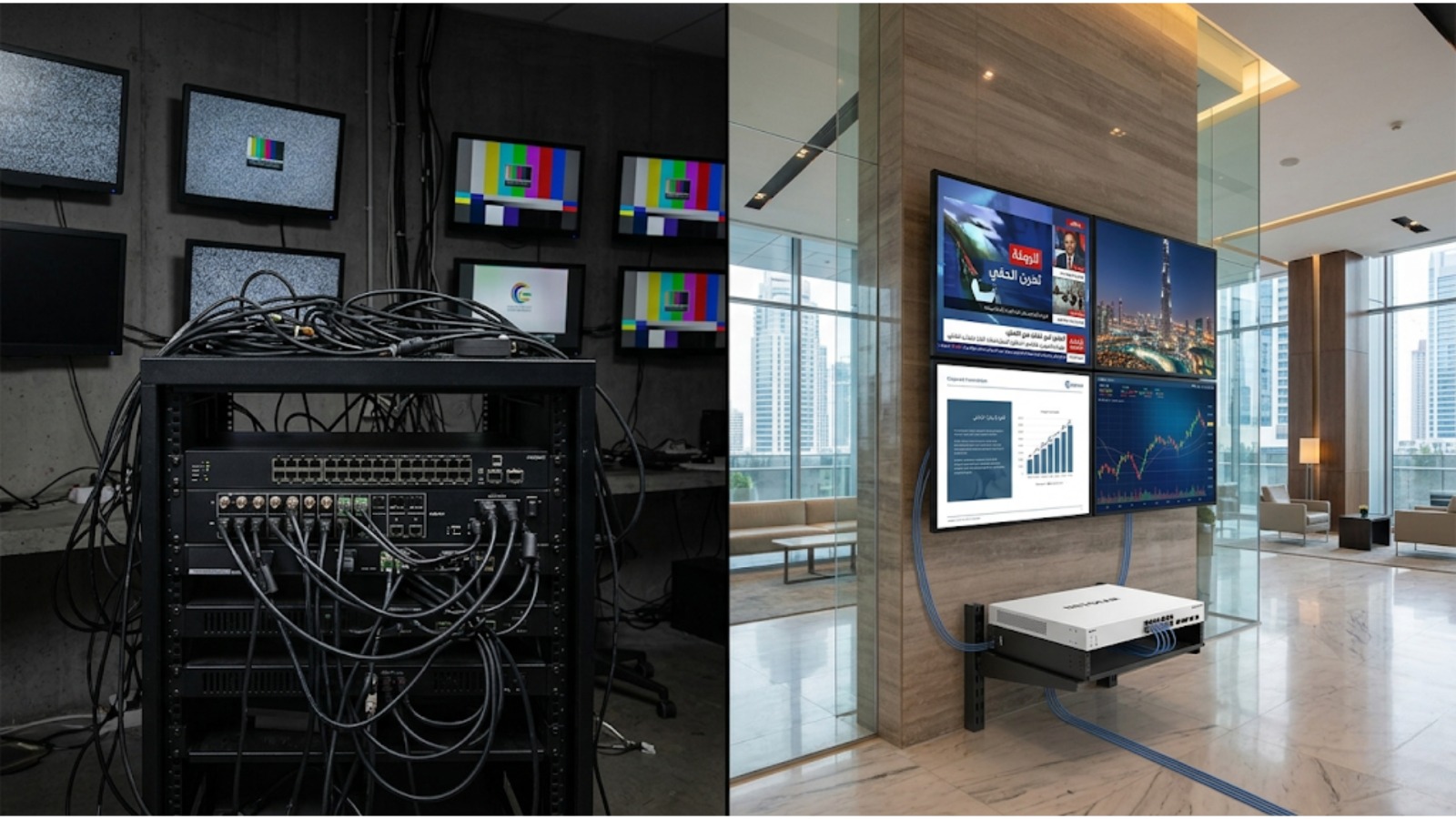
One of the most costly mistakes a project can make is to select the incorrect AV distribution method. A locked-in matrix switcher today becomes a forklift upgrade in three years. An over-spec’d AV over IP rollout on a weak network becomes a ticket queue nobody wants to answer.
This guide cuts through the noise by the DTIS team. Here’s exactly guide on AV over IP vs traditional audio visual distribution, when each one earns its place, and how UAE integrators are using both to deliver projects that actually scale.
What Is AV Over IP?
AV over IP (AVoIP) transmits encoded audio and video as data packets across a standard Ethernet network. Instead of a fixed matrix switcher, you get encoders at the sources, decoders at the displays, and a managed network switch in the middle.
The result: any source can route to any screen through software. Add a display? Plug in another decoder. Need to span a campus? The signal travels over the same fibre and copper your IT team already runs.
What Is Traditional AV Distribution?
Traditional AV uses dedicated point-to-point cabling, HDMI, SDI, or HDBaseT, running through a fixed-port matrix switcher. A 16×16 matrix has 16 inputs and 16 outputs. Period.
It’s reliable, predictable, and brutally simple to operate. The trade-off is rigidity. Outgrowing your matrix means replacing it. Moving a display means pulling new cable.
Comparison Table of AV Over IP and Traditional AV
| Factor | AV Over IP | Traditional AV |
| Scalability | Unlimited via network | Capped by matrix ports |
| Distance | Building or campus-wide | ~100m per HDBaseT run |
| Routing | Software, instant | Physical recabling |
| Latency | 1G compressed / 10G zero | Zero, uncompressed |
| Cost (small jobs) | Higher upfront | Lower upfront |
| Cost (large jobs) | Lower over lifecycle | Climbs with expansion |
| IT skill needed | High | Low |
| Security | Native AES encryption | Air-gapped by default |
| Future-proofing | Firmware-upgradeable | Hardware-locked |
The honest takeaway: AVoIP wins on flexibility and scale. Traditional wins on simplicity and predictable latency.
AV Over IP vs. Traditional AV: Similarities & Differences
Both systems share one goal: getting the right audio and video to the right screen, reliably. But how they get there is where everything changes.
Traditional AV uses dedicated hardware like matrix switchers, fixed cables, and physical routing. AV over IP does the same job but over your existing network, using encoders, decoders, and a standard IP switch. Same outcome. Smarter path.
1. Audio/Visual Control
Traditional AV locks each source to a fixed display. Need to change routing? You are pulling cables or calling an installer.
AV over IP gives you software-level control. Route any source to any screen in seconds, from a single dashboard. No screwdriver needed.
Which is Better? For fixed, single-purpose rooms, traditional works fine. For meeting rooms, auditoriums, or multi-zone spaces where layouts shift regularly, AV over IP wins hands down.
2. Scalability
Add a new display to a traditional system and expect new cables, new hardware, and a bigger bill. Every expansion becomes a project.
With AV over IP, your network is already the backbone. Adding a screen means plugging in a decoder. Your infrastructure scales without starting over.
Which is Better? Small, permanent setup? Traditional AV holds its ground. Planning for growth? AV over IP is the only logical choice.
3. Remote Management
Traditional AV goes down and someone drives to site. That is the reality. Physical systems need physical hands.
AV over IP lets you monitor, troubleshoot, and reconfigure from anywhere. One dashboard, multiple locations, zero travel.
Which is Better? Single-room installs will not feel the difference. But for campuses, retail chains, or multi-site venues, remote management alone justifies the switch to AV over IP.
4. Customization Limitations
Traditional AV is designed once and locked in. Renovate a room or repurpose a space and you are rewiring from scratch.
AV over IP adapts with you. Reassign screens, restructure zones, or completely redesign a layout through software with minimal physical changes.
Which is Better? If your space is permanent and predictable, traditional AV is sufficient. If your environment evolves, and in 2026 most do, AV over IP gives you the freedom to keep up.
5. Affordability
Traditional AV looks cheaper upfront and sometimes it is, for very small installs. But the moment you need to expand, reconfigure, or troubleshoot on-site, costs stack up fast.
AV over IP runs on standard IT cabling like CAT6 and fiber that your building likely already has. Less specialized hardware, fewer labor-intensive changes, and no expensive proprietary matrix switchers eating your budget.
Which is Better? For a single boardroom, traditional AV can be more economical. For anything mid-size or growing, AV over IP delivers better long-term value and the ROI becomes obvious within the first upgrade cycle.
When AV Over IP Is the Smarter Choice
Pick AVoIP when the project shows any of these signs:
- More than 8 endpoints, with growth on the roadmap
- Multi-zone routing across floors, buildings, or sites
- Video walls, multi-view, or KVM-over-IP in the brief
- Centralised management across remote locations
- Network is already in place (or budgeted into the build)
- Encryption and access control are non-negotiable (defence, finance, healthcare)
AVoIP platforms like WyreStorm NetworkHD are built for exactly this. They scale from hundreds of endpoints in a single hotel to thousands across a smart campus, all managed from one dashboard.
When Traditional AV Still Wins
Traditional matrix and HDBaseT systems aren’t obsolete. They’re the right call when:
- The room layout is fixed and small (one boardroom, one classroom, one signage zone)
- Zero-latency uncompressed signal is mandatory and budget rules out 10G SDVoE
- No managed network exists and adding one isn’t justified
- Lowest upfront cost is the deciding factor
- All displays sit within 100m of the rack
For a single signage display behind a hotel reception desk? Traditional. For the full hotel? AVoIP.
Network Requirements for AVoIP
This is where most AVoIP projects succeed or fail. Before you commit, your network needs:
- Sufficient bandwidth. 1G handles compressed AVoIP. 10G is needed for uncompressed 4K60 SDVoE.
- IGMP snooping enabled on managed switches to handle multicast traffic
- VLAN segmentation to separate AV from corporate data
- Cat6A cabling as the minimum standard for future 10G readiness
- PoE+ or PoE++ for powering encoders/decoders where applicable
- Fibre uplinks between buildings or floors for longer runs
Cutting corners on any one of these turns into pixelation, dropped streams, or a system that “works most of the time”, the worst outcome on a B2B project.
AV Distribution Choices for UAE Projects
In the UAE and wider GCC, project profiles tilt heavily toward AVoIP for one reason: scale.
Hotels and hospitality. Properties on Sheikh Zayed Road or Palm Jumeirah commonly run 200+ displays across guest rooms, lobbies, F&B zones, and ballrooms. AVoIP is the only practical choice.
Government and defence. Command centres, control rooms, and secure briefing rooms demand AES-encrypted distribution with centralised access control. AVoIP platforms certified for military-grade environments handle this natively.
Retail and malls. Dubai Mall–scale signage networks span kilometres of cable run. Fibre-backed AVoIP keeps content synced across zones from a single CMS.
Houses of worship. Larger mosques with multiple prayer halls and overflow zones use AVoIP for live multi-screen video distribution during peak periods.
Education. University campuses across Abu Dhabi and Sharjah deploy AVoIP for cross-building lecture capture and active learning classrooms.
5 AVoIP Installation Mistakes to Avoid
Even good products fail when installed wrong. The five errors we see most often on UAE jobsites:
- Wrong network switch. Unmanaged or consumer-grade switches kill multicast performance. Use managed AV-grade switches.
- IGMP snooping disabled. Without it, every AV stream floods every port and chokes the network.
- Mixing 1G and 10G gear carelessly. Hybrid setups need deliberate design or high-bandwidth streams will bottleneck.
- Skipping VLAN setup. AV traffic on the corporate VLAN is both a security and performance risk.
- Under-spec’d bandwidth. Calculate worst-case simultaneous streams, then add headroom for growth.
Get these five right and most AVoIP projects run themselves.
Hybrid AV: The Best of Both Worlds
Here’s what marketing rarely admits: most well-designed projects in 2026 are hybrid.
A typical setup looks like this. AVoIP across the campus backbone for flexibility and reach, with HDBaseT or local HDMI inside individual rooms where simplicity wins. The matrix switcher handles the boardroom. The IP network handles everything between buildings.
This hybrid approach gives you AVoIP’s scalability where it counts and traditional AV’s reliability where overcomplicating things doesn’t pay off.
Final Words
There is no universal winner between AV over IP and traditional audio visual solutions. The right system depends on your space, your budget, and where your project is heading in the next three to five years.
Small room, fixed layout, tight budget? Traditional AV does the job without overcomplicating things. Multi-zone, growing installation, or a facility that needs central control? AV over IP is built for exactly that.
The worst decision is choosing based on upfront cost alone and rebuilding two years later. The best decision is choosing based on where your project actually needs to go.
Frequently Asked Questions
Is AV over IP better than HDMI matrix in 2026?
For multi-zone or growing installations, yes. For a single fixed room, an HDMI matrix is still cheaper and simpler.
Does AV over IP cause latency?
1G compressed AVoIP adds milliseconds, which is fine for signage and presentation but noticeable for esports or live broadcast. 10G SDVoE adds effectively zero latency.
Is AV over IP secure?
Yes. Enterprise AVoIP platforms include AES encryption, VLAN isolation, and centralised access control. Often more secure than traditional setups.
Can I mix AV over IP and traditional AV?
Yes. Hybrid designs are common, using AVoIP for backbone distribution and HDBaseT or HDMI for in-room work.
What network do I need for AV over IP?
Managed switches with IGMP snooping, Cat6A cabling minimum, VLAN segmentation, and 1G or 10G bandwidth depending on resolution and codec.
Which is cheaper, AV over IP or traditional AV?
Traditional wins on small fixed jobs. AVoIP wins on lifecycle cost for any project that scales or changes.
Plan Your AV Distribution With DTIS
Every project has its own answer. A boutique hotel doesn’t need the same system as a government command centre, and a single classroom doesn’t need what a smart campus does.
DTIS supplies and supports both worlds, WyreStorm NetworkHD AVoIP for scale and QS-Tech and HDBaseT for focused fixed installs, across the UAE, Saudi Arabia, and beyond. Talk to our team before you lock in your design.

