



Smart Boardroom vs Traditional Boardroom: The ROI of AV Integration in Dubai
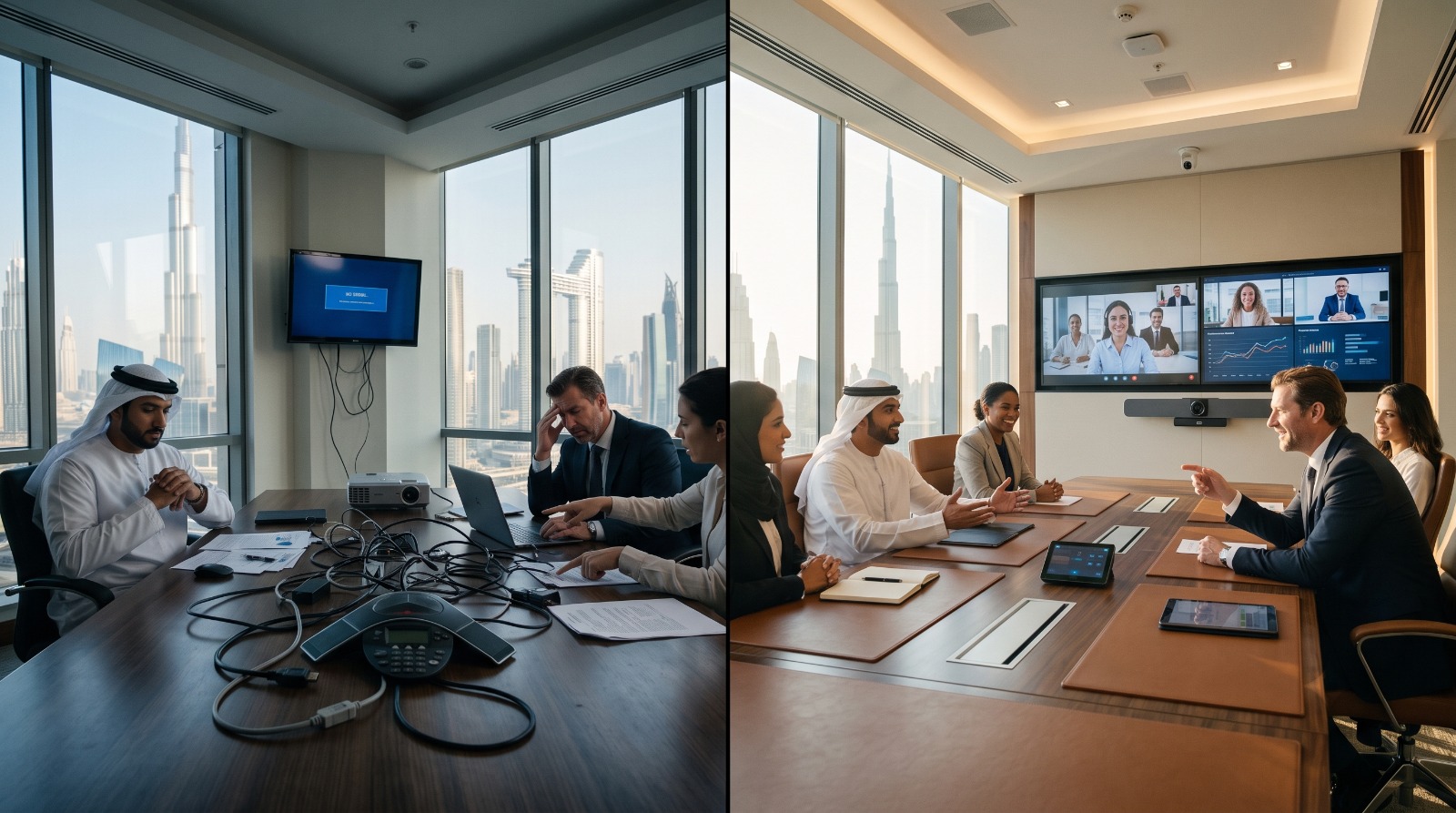
Your boardroom pays for itself through meetings that start on time and end with decisions, and the technology inside the room decides how often that happens.
For instance, your leadership team books the 14-seat boardroom in your Business Bay office for a 10 AM call with a client in Riyadh and a consultant in London. The presenter’s laptop needs a USB-C adapter nobody can find. The speakerphone picks up the air conditioning louder than the CFO, and the London consultant asks for every second point to be repeated. Twelve minutes pass before the first real decision. Repeat that across a full quarter and the boardroom becomes one of the most expensive rooms in your building.
The comparison below looks at both boardroom types through a financial lens: what each one costs, where the hidden losses sit, and how to calculate a realistic return on AV integration for a Dubai office.
Quick Answer
A smart boardroom combines displays, cameras, ceiling microphones, a DSP, wireless presentation and a central control system into one managed setup. Meetings start in under a minute, and IT can fix faults remotely. A traditional boardroom relies on standalone devices and cables, so time goes to setup, poor audio and support calls. For a busy Dubai boardroom, recovered meeting time and a lighter support load often pay back an integrated upgrade within 12 to 24 months.
What Separates a Smart Boardroom From a Traditional One?
Both rooms can look identical from the doorway. The difference sits in how the equipment connects, communicates and gets managed.
A traditional boardroom uses separate devices that each do one job. A smart meeting boardroom links every device through AV integration, so the display, camera, microphones, room PC and lighting respond to one touch panel or one calendar booking.
| Factor | Traditional Boardroom | Smart Boardroom |
| Meeting start | Manual cable connection, input switching and frequent adapter hunting | One-touch join through a room controller or wireless sharing |
| Audio pickup | Single tabletop speakerphone that misses voices at the far end | Beamforming ceiling microphones with DSP and echo cancellation across every seat |
| Camera | Fixed wide-angle webcam showing a distant view of the table | PTZ or AI-framing cameras that follow the active speaker automatically |
| Platform support | Works with one platform, while others need laptops and workarounds | Native Microsoft Teams Rooms or Zoom Rooms plus guest join for Webex |
| Content sharing | One HDMI cable at one seat controls who can present | Wireless presentation lets any approved laptop or phone share in seconds |
| IT management | Users report faults after the meeting has already failed | Remote monitoring flags offline devices before the meeting starts |
| Upfront cost | Lower initial spend on separate consumer or entry-level devices | Higher initial spend on design, integration, programming and commissioning |
| Running cost | Hidden costs in lost minutes, support callouts and repeat meetings | Predictable costs in licences, support contracts and scheduled firmware updates |
The traditional room wins on day-one price. The smart room wins on almost every factor that affects a meeting after day one, and that is where ROI is decided.
Where a Traditional Boardroom Quietly Costs You Money
The losses in a traditional boardroom rarely appear on an invoice, which is exactly why finance teams underestimate them. They show up as minutes, frustration and follow-up calls instead.
- Lost meeting minutes add up across every session, especially in rooms booked back to back from morning to evening.
- Repeat meetings happen because remote participants missed key points through poor audio or a frozen camera feed.
- IT support time goes to walking to the boardroom to switch inputs, reset a codec or replace a faulty HDMI cable.
- Client impressions weaken after a delayed or broken call, particularly during pitches and board-level negotiations.
- Hybrid attendees participate less when they cannot see the whiteboard or hear the far end of the table.
Independent research backs up the time loss. In Forrester’s Microsoft Teams Rooms study, interviewed users said that getting meetings started could take at least 5 to 10 minutes per meeting before a dedicated room system was in place. forrester
How to Calculate the ROI of AV Integration Dubai
A credible ROI case uses your own booking data, not vendor brochures. Five steps cover it.
1) Count your real meeting hours. Pull 90 days of boardroom booking data from Outlook or Google Workspace. Note meetings per week, average attendees, and how many sessions include remote participants. Hybrid calls carry the highest technical risk, so track them separately.
2) Put a price on lost minutes. Estimate how long each meeting loses to setup and troubleshooting, using attendee feedback or call logs. Multiply the lost hours by the average loaded hourly cost of the people in the room. Senior leadership time in Dubai carries a high hourly value, which raises the cost of every delay.
3) Add IT and support time. Count the tickets and walk-up support visits linked to the boardroom. Forrester’s composite organisation saved 8,791 hours on room issue resolution after deploying Teams Rooms, which shows how much support time remote management can free up.
4) Include licences, beyond the hardware. Room licences and support contracts recur every year. UC Today’s 2026 cost analysis of a 20-room Teams setup found licensing alone running 87% higher than the annualised hardware cost, so budget for total cost of ownership over three to five years.
5) Work out the payback period. Divide the total project cost by the monthly value you recover.
Worked example: A Dubai boardroom hosts 10 meetings a week with 6 attendees each, loses 7 minutes per meeting, and has an average loaded cost of AED 200 per person per hour. That adds up to 7 hours of lost people-time every week, worth AED 1,400. Across 48 working weeks, the loss reaches AED 67,200 a year, or AED 5,600 a month. An integrated upgrade costing AED 90,000 pays back in about 16 months from recovered time alone, before counting lower support load or fewer repeat meetings.
At enterprise scale the numbers grow further. A Microsoft-commissioned Forrester study recorded USD 1.63 million in benefits against USD 370,000 in costs over three years for its composite organisation.
Dubai-Specific Factors That Shape Boardroom ROI
Dubai offices bring their own conditions, and they change how a boardroom performs and how fast an AV investment pays back.
- Glass-heavy towers in Business Bay, DIFC and Dubai Marina reflect sound and create echo. Acoustic treatment and DSP tuning matter as much as the choice of microphone.
- Multi-platform client bases across the GCC can mean a Teams call with a government entity, a Zoom pitch and a Webex review in one morning. Guest join and wireless BYOD sharing keep each of those meetings starting on time.
- High heat and fine dust shorten the life of poorly ventilated equipment. Integrators specify ventilated racks or dedicated AV rooms to protect the hardware.
- Multi-site operations across Abu Dhabi, Riyadh and Doha benefit from central monitoring platforms such as Crestron XiO Cloud or Q-SYS Reflect, which let one IT team manage every room.
- Grade A buildings carry smart-building expectations. Occupancy sensors linked to the building management system switch off displays and release unused bookings automatically.
Local conditions turn a well-designed smart boardroom from a convenience into a reliability requirement.
Is a Smart Boardroom Always the Better Investment?
A smart boardroom gives the strongest return in rooms with heavy, hybrid and client-facing use. A simpler setup still suits a room that hosts quarterly in-person board meetings with no remote attendees.
A phased upgrade also works well for tighter budgets:
- Upgrade audio first, since clear sound fixes the biggest hybrid complaint.
- Add a dedicated room system next.
- Bring in central management once the budget allows.
Your usage data should drive the decision more than any spec sheet. For guidance on matching technology to different room sizes, see our article on how AV technology enhances meeting room productivity.
Frequently Asked Questions
How much does a smart boardroom cost in Dubai?
Cost depends on room size, seat count, number of displays, microphone coverage, control system and licences. Ask for a quote that separates hardware, integration labour, programming, licences and annual support, so you can compare total cost of ownership across vendors.
How long does a boardroom AV upgrade take?
On-site work for a single room usually takes a few days after design approval, depending on cabling and ceiling works. Equipment lead times and building fit-out approvals can add weeks, so plan ahead of the quarter you need the room.
Can an existing traditional boardroom be converted?
Yes. Existing displays and cable paths can often stay. A typical retrofit adds ceiling microphones, a DSP, a room system or video bar, wireless presentation and a touch controller, which avoids a full rebuild.
What is a good payback period for AV integration?
A heavily used boardroom can reasonably target payback within 12 to 24 months. Rooms with fewer weekly meetings take longer, which is why booking data should come before budget approval.
Does a smart boardroom need a strong network?
Yes. Room systems, AV over IP and cloud management all run on your network. Check VLANs, QoS and bandwidth for HD video before buying any hardware.
Making the Right Boardroom Decision
A boardroom upgrade works best as a business decision backed by numbers. Start with your booking data, price the lost time, include licences and support, and compare payback periods for each option. For a second opinion on room design or a total cost breakdown, the DTIS consultancy and design team can review your current setup and usage before any equipment is chosen.

